Buying Guide
Buying Property in Gurgaon From Abroad: What NRIs Actually Need to Get Right in 2026
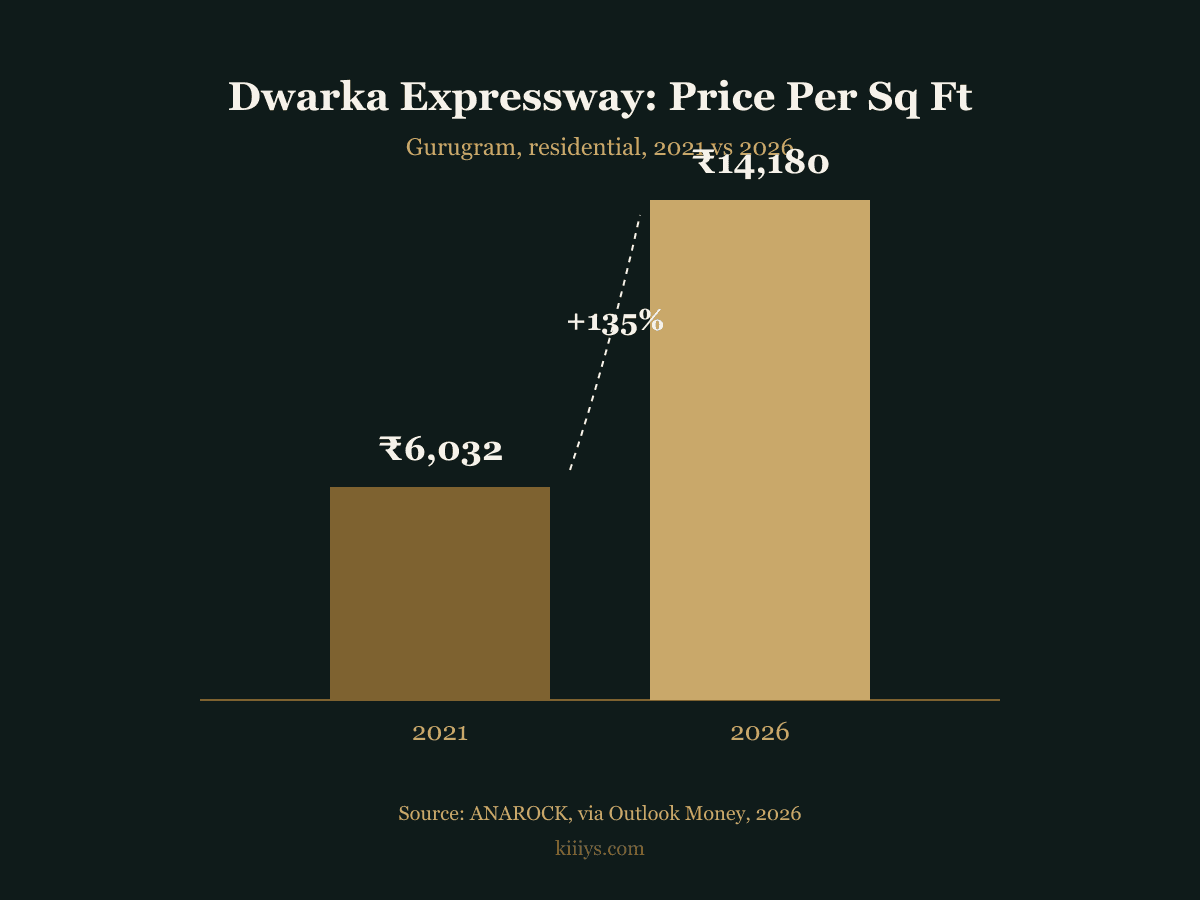
A three-bedroom apartment on Dwarka Expressway cost about Rs 6,032 per sq ft in 2021. By 2026, ANAROCK puts the same stretch at roughly Rs 14,180 per sq ft, more than double in five years. If you're an NRI tracking that from Dubai, London or New Jersey, the real question isn't whether Gurgaon is worth buying into. It's whether you actually know what buying from outside India requires right now, because three different pieces of the process changed or got tightened this year.
I get versions of the same question from NRI buyers every month: can I even buy this, how does the money move, and what happens when I eventually sell. Here's what's actually true, and where the rules are genuinely still being worked out.
What FEMA Lets You Buy, and What It Flatly Won't
Under the Foreign Exchange Management (Acquisition and Transfer of Immovable Property in India) Regulations, 2018, NRIs and OCIs get general permission to buy residential and commercial property in India. No RBI approval needed, no case-by-case clearance. That's the good news, and it hasn't changed.
What's off-limits hasn't changed either: agricultural land, plantation property, and farmhouses. If a broker tells you there's a workaround for any of these through a POA or a trust structure, that's a flag, not a feature. Stick to apartments, builder floors, plots on residential land, and commercial units, which is most of what Gurgaon's new-launch pipeline is anyway.
The Money Has to Move Through the Right Door
Every rupee has to route through an NRE, NRO, or FCNR(B) account, full stop. Cash payment isn't a shortcut, it's a FEMA violation, and sources citing enforcement action put the penalty at up to three times the transaction value. If a seller or a broker suggests "part cash, part cheque" to save on stamp duty, you are not saving money, you are creating a problem that surfaces later, usually when you try to sell or repatriate.
Keep every wire transfer documented from day one. You will need that paper trail again, for the exact reason in the next section.
Selling Later: TDS Just Got More Complicated, Not Less
This is the part most NRI buyers don't think about until they're already selling, and 2026 is a bad year to stay vague about it. The Income-tax Act, 2025 moved NRI property transactions to Section 393(2), and the Income-tax (Fifth Amendment) Rules, 2026, notified on 22 September, shift the compliance process to a PAN-based route from 1 October 2026, no TAN required for the buyer.
On the rate itself, I'll be honest: sources disagree, and I'm not going to quote you a number with false confidence. Multiple tax advisories cite a long-term capital gains rate of 12.5% without indexation, with surcharge and cess pushing the effective ceiling toward roughly 15%. Others describe the withholding as simply "the rate in force," tied directly to the capital gains rate on the full sale value from the first rupee, which is a meaningfully different calculation if your gain is small relative to the sale price. Get the exact notified rate from a CA before you sign anything, not from a blog, including this one.
Two things that are solid: capital gains tax has to be settled in India before any repatriation, and a lower or nil-deduction certificate under Section 395(1) is worth applying for in advance if your actual gain is well below what flat withholding would assume. It saves you from parking money with the tax department for a year waiting on a refund.
Repatriation Has a Ceiling, and DTAA Won't Save You From Indian Tax
RBI's general remittance limit from an NRO account is USD 1 million per financial year. That's not a property-specific rule, it's the broader ceiling, but it applies here too, and it requires a CA's Form 15CB certifying tax compliance before the bank will process the outward remittance.
Here's the part that surprises people: your Double Taxation Avoidance Agreement with your country of residence generally will not exempt you from Indian tax on this. Most DTAAs say gains on immovable property are taxed where the property sits, which is India, regardless of where you live. What the DTAA usually does give you is a foreign tax credit back home, so you're not taxed twice on the same gain, but you are definitely taxed once, in India, first.
The Power of Attorney Problem
If you're not physically in India for the purchase or the registration, you need a POA, and a general one won't do. Name the specific powers: signing the agreement, paying installments, representing you at registration, taking possession. A POA executed abroad typically needs notarization and consular attestation (apostille where applicable) before an Indian sub-registrar will accept it. Whether it then needs separate registration in India once it arrives is a point where sources actually disagree, so confirm with the specific sub-registrar's office you're dealing with, not a generic guide.
Why Gurgaon, Specifically, Right Now
HARERA approved roughly Rs 27,000 crore in new Gurugram project value between January and April 2026 alone. Gurugram accounted for 43% of all NCR residential sales in Q2 2026. The corridor driving a lot of that, Dwarka Expressway, is the same stretch that moved from Rs 6,032 to roughly Rs 14,180 per sq ft since 2021. NRI inflow data specific to 2026 is thin, but JLL's most recent clean figure (Q1 2025) showed a 27% year-on-year jump in NRI-linked demand, and nothing in the 2026 numbers suggests that cooled off.
None of that tells you whether a specific project is the right project. It tells you the corridor isn't quiet, and that RERA registration on whatever you're looking at matters more than ever when supply is moving this fast.
What I'd Actually Check Before Wiring Any Money
- The project's RERA number, verified directly on haryanarera.gov.in, not from a brochure
- Which account type (NRE/NRO/FCNR) the payment is routing through, and that it's fully traceable
- Whether you need a POA for this specific transaction, and whether it needs attestation plus registration or just attestation
- The actual notified TDS rate for your situation from a CA, not an estimate from any article
- Whether a lower/nil-deduction certificate application makes sense before you eventually sell
- Your country's DTAA treatment of Indian property gains, so repatriation timing doesn't surprise you
We track RERA status and verified project details for Gurgaon and NCR launches on kiiiys.com, same as we do for every local buyer.
If you're an NRI who's already been through this, what's the step that actually slowed you down, the paperwork or the money transfer?
Sandeep Gupta
Sandeep Gupta, CA, MBA · Founder, Kiiiys — Haryana RERA–registered real estate agent with 20+ years in global tech and finance and 3 years advising homebuyers in Gurgaon.
More Guides
L&T and Prestige Just Entered Gurgaon's Dwarka Expressway. Neither Has a RERA Number Yet.
L&T spent ₹1,123 crore and Prestige signed a ₹4,200 crore deal on Dwarka Expressway in 2026. Neither has a RERA number yet. Here's what's confirmed.
RERA in Gurgaon: What It Actually Protects You From (and What It Doesn't)
What Haryana RERA actually guarantees when you buy an under-construction flat in Gurgaon — registration, carpet area, and what it doesn't cover.